























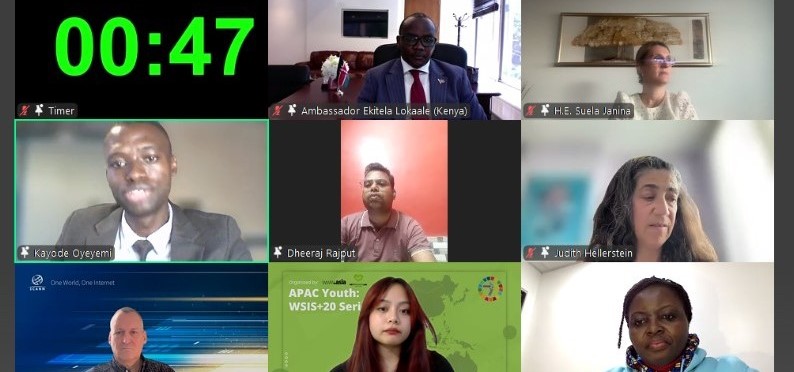
The Africa ICT Alliance (AfICTA) has issued a strong call to action for scalable, inclusive, and industry-aligned capacity-building initiatives to accelerate Africa’s digital transformation. Speaking during the WSIS+20 High-Level Stakeholder Consultation held on Tuesday, 29 July 2025, with diplomats and development stakeholders, Kayode Oyeyemi, Senior Programme Officer of AfICTA, emphasized that Africa’s young and dynamic population can be a global digital powerhouse if the right investments in skills and infrastructure are made.
Citing the World Bank’s 2023 report, Kayode noted that 230 million jobs in Sub-Saharan Africa will require digital skills by 2030. Yet fewer than 10% of African youth receive formal ICT training, compared to over 50% in Europe. He called for public-private partnerships to deliver large-scale training programs targeting youth and women (an example of an initiative mentioned was the “She Code” that transforms thousands of women’s lives in Nigeria), without sidelining underserved communities.
“Capacity building must prioritize localized digital content, language inclusivity, and industry-relevant skills in emerging technologies,” Kayode said. “We need to ensure Africa’s talent is globally competitive while meeting the needs of our local economies.”
In line with the vision of AfICTA, focus was also shifted to the importance of equipping Micro, Small, and Medium Enterprises (MSMEs), the backbone of Africa’s economy, with the digital skills to thrive in e-commerce, digital finance, and online markets. According to the International Finance Corporation (2022), 40 million of Africa’s 100 million MSMEs lack access to digital tools, limiting their market reach.
With Africa’s 1.5 billion people and over 300 million jobs tied to MSMEs, AfICTA urged stakeholders to envision the transformative impact of full digital integration across these enterprises. AfICTA’s recommendations include:
1. Establishing regional centers of excellence for ICT skills development.
2. Embedding annual WSIS (World Summit on the Information Society) reviews into national digital strategies to track progress on capacity building and the Sustainable Development Goals (SDGs).
3. Strengthening partnerships between Africa’s private sector and global development partners.
4. Adopting measurable frameworks for monitoring skills development progress.
“The future of Africa’s digital economy depends on bold action today". Together, we can build Africa’s digital future and empower our people for meaningful participation in the global digital economy.
About AfICTA
The Africa ICT Alliance (AfICTA) is a private sector-led alliance of ICT associations, multi-national corporations, companies, organizations, and individuals in the ICT sector across Africa. AfICTA’s vision is to fulfill the promise of the digital age for everyone in Africa.